Phone: GrapheneOS
I switched my phone from Apple to GrapheneOS. Not mainly for privacy, mainly for freedom. I can run whatever apps I want, code on the phone if I feel like it, and nobody nags me with TestFlight approvals. I install from Zapstore, from Obtainium, or just sideload an APK.
Android 17 is a modern OS. The Pixel 10 Pro Fold I’m using is the best phone I’ve owned, and the foldable form factor is great.
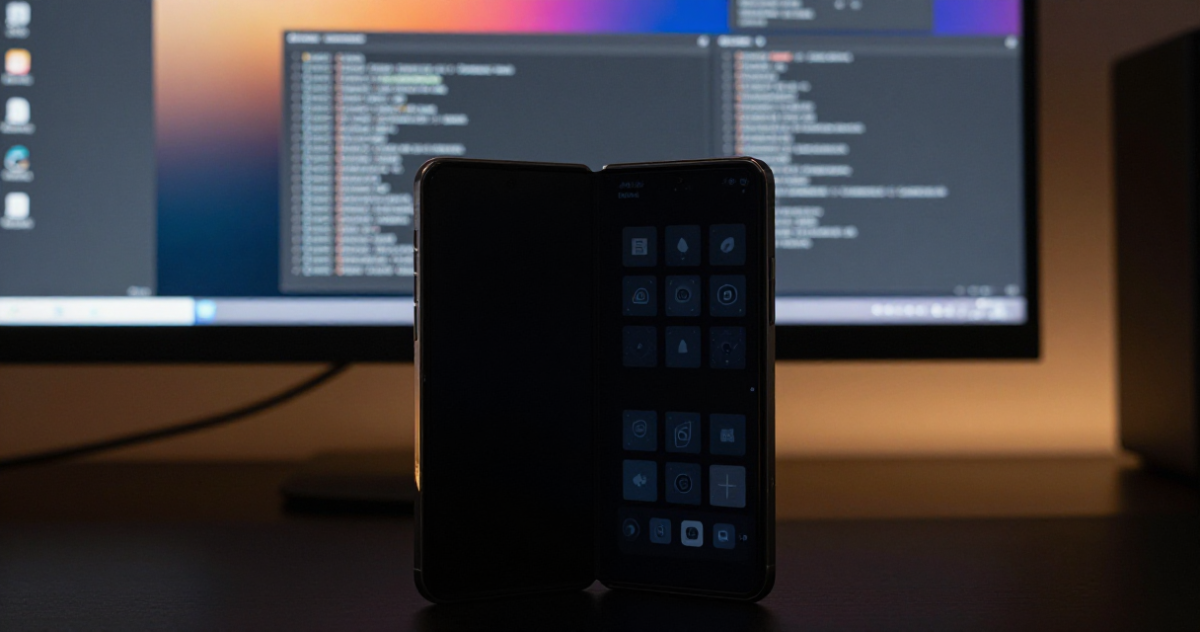
I can plug a display, keyboard, and mouse into the USB port and get a mini computer I actually use often. My workstations are scattered around, so when I need to order something, write something, or click through a task quickly, I walk up, plug in, do it, and move on. Wilder wrote about exactly this setup on his blog.
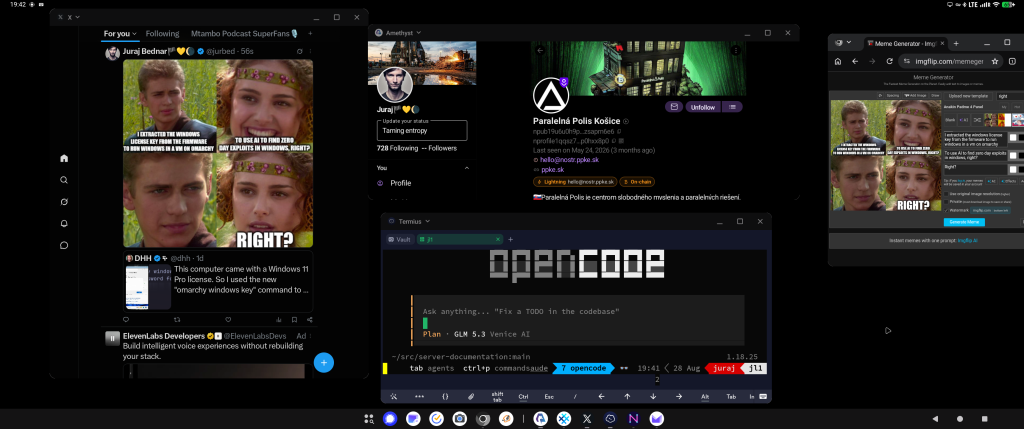
Image: Screenshot from the trenches of the memetic wars – me using GrapheneOS in desktop mode.
So for me this is mostly about freedom and usability. Being able to control exactly which apps see what is just a bonus. I’m not running three separate profiles or going without Play Services. I’m not a hardcore user, and I don’t need to be.
Day to day this is simply better than Apple for me, even though my laptop is still a Mac. The one thing that doesn’t work is cut and paste to the Mac. I rarely need it, and when I do, LocalSend or a note to myself in SimpleX or Signal covers it. Photo sync would also work through Google, but I use Proton Drive, which syncs photos automatically. It’s not the smoothest workflow, but I’m not someone who photographs everything constantly, so it doesn’t cost me much.
Opening the phone and getting a tablet I already carry in my pocket is really useful. My classic use case is comparing hotel prices: I open Booking and Travala side by side and click through both at once.
So for me the original premise was already wrong: “privacy, but user-unfriendly” versus “user-friendly, but less private.” GrapheneOS is more user-friendly for me. It’s a solid, modern operating system built on Android 17, with great apps.
Google Pay doesn’t work on GrapheneOS, so I keep a physical card in my phone case and tap to pay. There’s no real difference in the experience.
Google Play Integrity hasn’t failed me with any banking app so far. The only app that complains is my car’s app, and it wants a subscription I wasn’t paying for even when it worked.
I use Google Maps too, but lately I’ve discovered Mapy.cz, and I use OsmAnd a lot because it’s better for certain things. If I need a toilet or drinking water for the camper, OsmAnd marks both. Google Maps doesn’t.
Why iPhone isn’t automatically more user-friendly
There’s a bigger assumption worth questioning here too: that things like photo sharing through iCloud are automatically more convenient. In my experience that’s less and less true, because more people are on Android every year. The idea that you can share a photo album with everyone you’re traveling with because everyone has an iPhone doesn’t hold anymore. On my last three trips, only one had an iPhone present at all, and on two of them there were none.
It also used to be that iPhone users were the ones with money, and Android was for people who couldn’t afford better. That’s not true anymore either. Foldable Pixels cost more than iPhones now, and I travel with people who are successful and financially comfortable who choose Android specifically for the flexibility.
My partner had an iPhone 13 mini and wanted an upgrade once it started feeling slow and clunky. Apple stopped making a small form factor, and every new iPhone is bigger, so none of them fit comfortably in her hand or her pocket. She reluctantly tried a Motorola Razr Ultra, a flip phone that folds down smaller than the iPhone 13 mini even was. She expected a painful adjustment to Android. Instead everything just worked, the phone is genuinely usable closed, there are plenty of apps, the camera is good, and she isn’t missing anything. The assumption that switching away from iPhone means downgrading your experience doesn’t hold up.
Laptop: Omarchy
On the laptop side I’m still on a Mac, though I’m now trying Omarchy. My Apple Silicon hardware doesn’t run Linux well, so I’ve been running Omarchy in full-screen mode on a second display instead, mostly to try it out.
Omarchy is a Linux distribution built on Arch Linux that runs a tiling window manager by default and ships with an excellent launcher. There’s nothing to hack or tune, it works right after install. It’s maintained by DHH, the creator of Ruby on Rails.
Billionaires and CEOs who already built enormous value are going back to coding themselves now that AI is here. Tobi Lütke, CEO of Shopify. DHH, the creator of Ruby on Rails, now builds Omarchy. Jack Dorsey, the founder of Twitter, runs three separate projects: Bitchat, mainly a Bluetooth mesh chat that works even without internet, with Nostr only as a secondary transport, and we use it on Lunarpunk exactly for that offline capability; Goose, an AI agent harness; and Buzz, a decentralized replacement for Slack or Discord. They no longer need the money, so they build open source for the sake of building itself. It reminds me a lot of the themes in Tamers of Entropy, creation as resistance against entropy. And it’s a little wild that CEOs of massive corporations now sit alone with AI agents and write code.
Funny enough, they know it themselves. DHH made a parody site for Omarchy called oligarchy.fyi, poking fun at exactly this: “Zero dollars. Several billionaires,” with a single link back to omarchy.org. Self-aware, from someone who can afford to be.
I like how Amir Taaki put it: “Linux tried to be Windows, but cheaper.” The KPI became handing a machine to a secretary at some company in a way that she wouldn’t notice it wasn’t Windows: a taskbar, a Windows-style button, an office suite clone. Copying Windows or the Mac erases the actual advantages of Linux.
Omarchy breaks that pattern entirely. It ships with a tiling window manager by default, a solid launcher, and it looks good. Everything works out of the box, with no need to hack on config files or go full geek mode to get there, and it looks nothing like Mac or Windows. It looks and works differently from a Mac, but that doesn’t make it worse, just different.
So this is another false dichotomy for me. Linux isn’t automatically “annoying, ugly, and something you’ll be tuning forever, but at least it’s private and free.” When I’m running Omarchy on my second display, I actually want to work in it, because it’s more pleasant to look at, comfortable to use, and faster.
I only plug in a single cable, the display cable. The USB-C hub is built into the monitor itself, and it charges the phone at the same time as it drives the keyboard and mouse. One cable in, and I have a full desktop plus a charging phone.
The compounding effect of freedom
Freedom and privacy also have a kind of compounding effect. The app Bitblik lets me convert sats into cash in my pocket, which makes getting hold of cash a lot simpler. It has a web version too, but that’s currently down because its domain stopped working. Through Zapstore, which pulls apps directly from Nostr, Bitblik keeps working anyway, because the app talks over Nostr and needs neither a domain nor an app store. Anyone running GrapheneOS with Zapstore gets uncensorable apps as a side effect, including apps someone would rather see banned. On iOS, Bitblik would run into several problems at once: the app would never get into the App Store, the developer would have to go through KYC, the app could be pulled at any time, and the user would have no fallback beyond the website, which can be taken down the same way. These second-order effects matter: what further freedom does the freedom you already have unlock?
GrapheneOS and Omarchy are, for me, genuinely more user-friendly than what I had before. Being able to control exactly what each app can see is a real bonus on top of that, not the main reason for the switch.