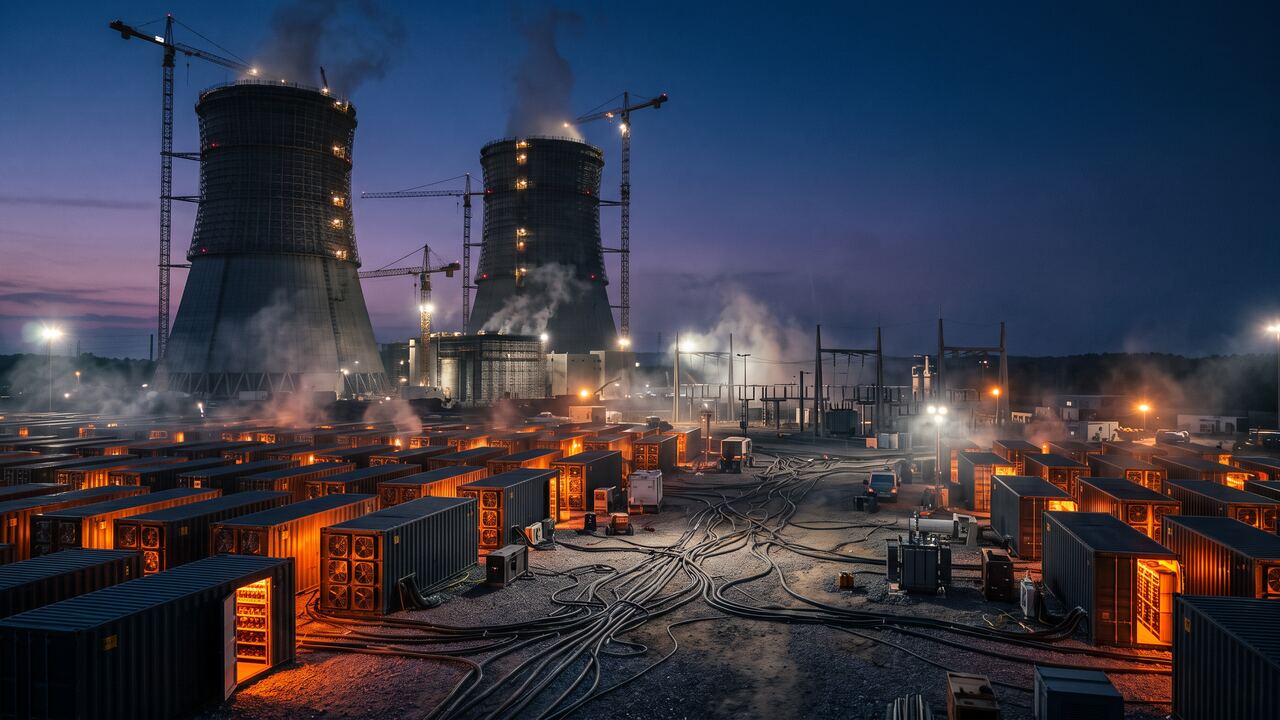
A friend told me recently that Bitcoin can’t go up 100x anymore because there isn’t enough electricity to mine it. He’s right that hashrate and price move together. I just think he has the causality backwards. Supply and demand set the price, and hashrate follows it.
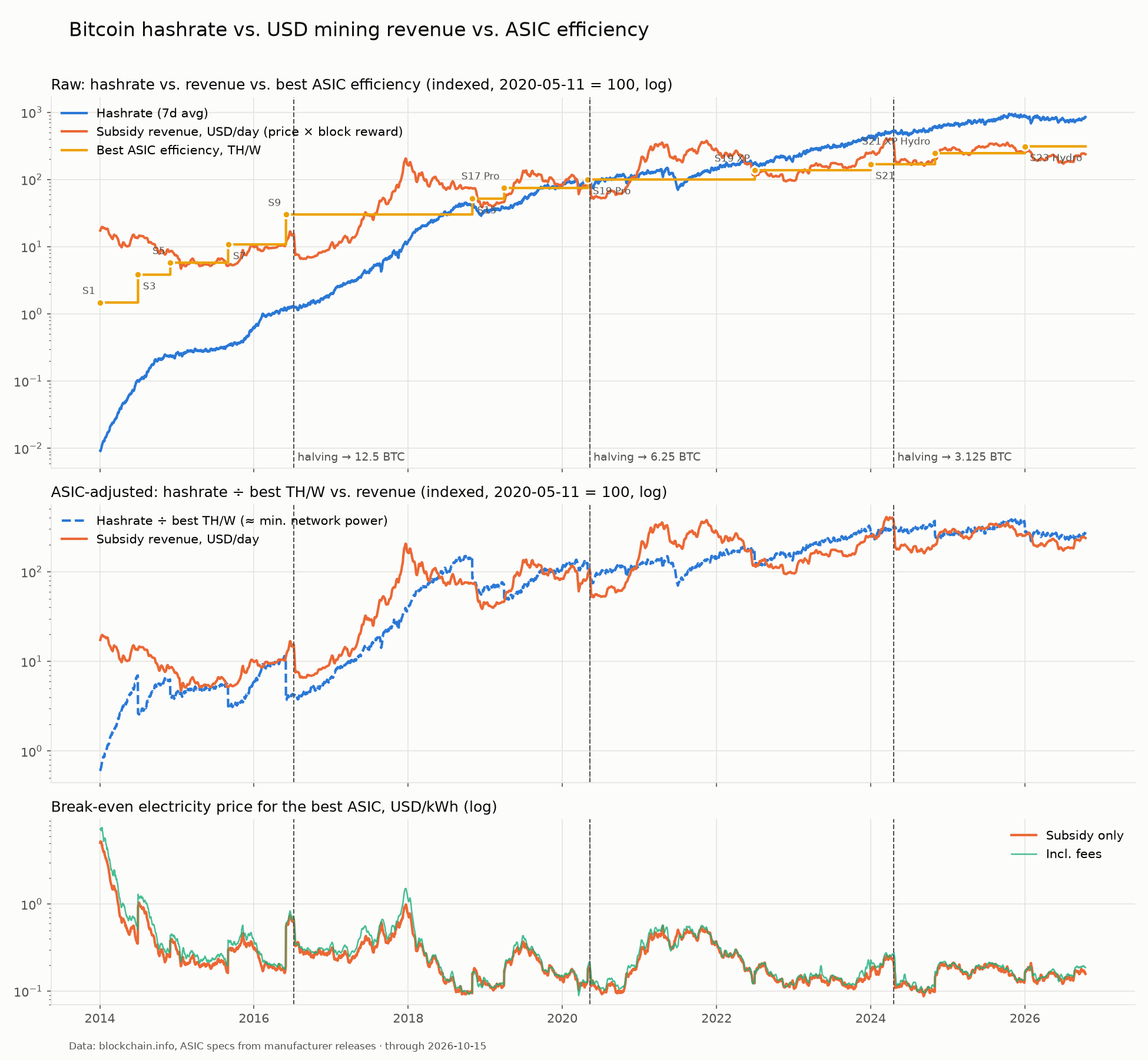
The top panel of the chart shows hashrate, miners’ USD revenue (price × block reward, which halves every four years) and the efficiency of the best ASIC on the market in TH/W. Hashrate grows about 30% a year faster than revenue.
In the middle panel I divided hashrate by the best ASIC’s efficiency, which went from 98 J/TH (S9) to 9.5 J/TH (S23 Hydro) in ten years. After that, the line sits right on top of revenue. The 30% a year gap was just better hardware. Hashrate is roughly revenue times efficiency, which means miners spend roughly all of their income on electricity. In the 2017 and 2021 bull runs, revenue shot up first and hashrate caught up later. That fits price driving hashrate, not the other way around.
The bottom panel is the electricity price at which the best ASIC still breaks even. Since 2018 it has stayed between about $0.10 and $0.50 per kWh. Today it’s around $0.16.
One consequence surprised me: better ASICs don’t reduce the power draw. Power is set by revenue divided by the price of electricity. A more efficient chip just turns the same watts into more hashes. Even 100x more efficient ASICs wouldn’t get you out of the problem.
Now the thought experiment. Say Bitcoin does 100x in today’s dollars after the next halving. That’s about $8 million per coin. With a 1.5625 BTC subsidy and 144 blocks a day, miners would earn about $1.8 billion a day, compared with roughly $37 million now. At today’s break-even electricity price, that pays for around 500 GW of mining. By my rough math that’s about 14% of the world’s electricity, or some 500 nuclear reactors (there are about 440 in the world today). If chips reach around 5 J/TH by then, hashrate lands near 100 ZH/s.
Nobody builds a power plant within one halving cycle, and TSMC won’t make 50 times more chips next year. For a while the break-even price of electricity would jump to dollars per kWh, and mining on expensive power would pay. That would last until new plants and new fabs caught up with the price.
What happens first? Do miners buy up the electricity that already exists and push the price up for everyone? Or does mining become the biggest customer for new nuclear or hydro, and construction starts?
Permits are the bottleneck I find interesting, because they’re an arbitrage. Miners can put a container anywhere, and they’ll go wherever a power plant gets built fastest. A country that can approve a dam or a reactor in months instead of a decade would get that money. One that doesn’t require permits at all would get it first. I’d like to see which countries are ready for that.